Showing posts with label #CauseAChatter. Show all posts

Wednesday, July 05, 2023

Book Review - Lost Edges by Salini Vineeth

Disclaimer: There may be a few spoilers and if you would like to read the book without being influenced by the review, please come back here after reading the book.

As reviews started coming in about the book, touching upon mental health and its importance, I decided to order the book. I placed the amazon order on 28 May 2023 and the book was due to be delivered on 30 May 2023. While I was eagerly awaiting to receive my book, Life had a different plan for me though. On 29 May 2023, I was injured in a freak road accident, admitted in the hospital for compound fracture in my right tibia & fibula which resulted in a surgery and put a long road of recovery. The book arrived on 30 May 2023 and my family brought it to the hospital the next day.

I started reading the book during my hospital stay. It helped me navigate through my own emotional journey during my recovery as I was reading about the life journeys of Geetanjali & Ravi. 

The very first chapter caught my attention specifically because of the aspect of how well it dwelled on the internal conundrum of Ravi in the waiting room of a mental health professional and the myriad of irrational thoughts that keep popping in his consciousness asserting the Tamil idiom “மனம் ஒரு குரங்கு” (Manam oru Kurangu - meaning our mind is a monkey – or more elaborately, our mind jumps around like a monkey with no rhyme or reason). As his mind jumps around, we also a get a glimpse of Geetu (Geetanjali) from his perspective. As the story progresses, it was a pleasure reading the inferences of events from both Ravi & Geetanjali’s perspectives. This is the reality of life. Every incident has multiple perspectives. These perspectives are from the biased views of the specific individuals who view them through their biased lenses that are a result of their lived experiences from childhood that shape their values systems and learning as a result of navigating situations & circumstances.

Amit, the friend who is the first point of contact for Geetanjali to seek out for professional relationship counselling, does justice to both his personal and professional relationship, by making sure that he just serves as a first point of contact guiding them towards the appropriate support systems either of them need and not letting the conflict of interest of the personal relationship cloud over the professional services that he could be providing. The hand off has been dealt very well.

The research for the book for addressing the sensitive topic of mental health care, childhood trauma and its long-lasting impact including the shaping of one’s persona, importance of therapy, the Indian context of the associated taboo & inhibition is evident in the way the plot unfolds. Both the lead characters have their fair share of childhood trauma and experiences that have been instrumental in shaping their coping mechanisms, which travels with them well into adulthood. 

Though Arnav as a character is very short lived in the plot, he still managed to make a place in my mind as I saw him to be an individual with a deeper character who could be largely misunderstood by most, as he does not care to fit into the societal mould of expectations. He is his own master and slave to none. 

I loved how the story ventured into the different relationships & their quality, that each of the lead roles have in their life – parental, sibling, and friends. And in doing so, the plot touches upon the way they perceive every challenge that life throws at them. Without mentioning the technical terms, the plot touches upon temperament, lived experiences, resilience, trauma, PTSD, self-medication (and its harm), and more. 

Kudos to the author, Salini Vineeth, for being verbal about the need for regular follow ups for prescribed medication and its adjustment for better mental health. She also highlights the need for the psychiatric treatment and therapeutic intervention to go hand in hand and overlap with each other for the intervention to be effective for the individual seeking these services and support. 

As a person who has been passionate about human behaviour and its drivers, I have consciously pursued to qualify myself to understand this from a holistic perspective in both educational context as well as in reading up about current research including interdisciplinary research in biology, sociology, & psychology that shed light on the interplay of these fields in driving human behaviour. From this position, I would say the Salini Vineeth has done a fabulous job of bringing the interplay of emotions, relationships, and environment on an individual’s behaviour shaping beautifully. The importance of appropriate support systems and the complexity of its availability in the Indian context is also well highlighted. 

I would recommend that this book be read by mental health professionals too for them to understand the client’s world with its multiple layers and their complex interplay on the client’s cognition, behaviour, and everyday choices. This will enrich the therapeutic intervention for the client, as it will be an approach that is holistic. It might also motivate the therapist/professional to explore & understand areas outside their specific area of expertise, thereby making eclectic intervention a norm in therapeutic strategy! 

Salini Vineeth – also an alumnus like me from BITS, Pilani, has also authored other books: 

  1. Everyday People: Tales of People you know, a collection of short stories. This was the first book that I read. What pulled me to read this was her Tiny Tales. I have been a fan of her writing long before this book because of Tiny Tales. She has a way with words in expressing the layers in the fabric of human emotions and interaction.
  2. Magic Square, a novella. This is on my TBR (To Be Read) list.
  3. Travel Guides for Hampi and Badami.

In addition to the above self-published books, she has also been part of a few anthologies. Her stories have also been published in various magazines. You can find the links to these on her website.

This post is also part of Blogchatter’s #TBRChallenge 2023. This blog is also part of #CauseAChatter challenge, as this book focuses on individual mental health and its long standing impact on relationships through its various characters. 

This is not a sponsored review.

Monday, March 20, 2023

My first (collaborative) book – Journey so far and the path ahead

In the last 5 years, I have self-published couple of books exclusively for my family circle and an e-book on Blogchatter. Yet the possibility of working on a book for a global audience, and with a publishing house, from the scratch is always a first-time experience. Guess this is the novelty that keeps authors (and budding ones) to continue working on books and articles. Having engaged readers, like you, is always a pleasure, as it helps in improving my skills as a writer. 

Raising Children in a Changing World
I remember when I first saw the email from Let’s Author in July 2022 requesting me to get in touch with them, to get onboarded as an author for a parenting book titled How to Parent in a Crazy World. I thought that the email was a phishing email.

So the first step was to search for Let’s Author online, and to my surprise, I saw my college senior’s post on social media where she was backing an author for the book One for the Road. I still went ahead and ignored this email for almost a month or more. Suddenly in September 2022, I find the same message from Let’s Author on my LinkedIn messaging Inbox. This time I decided to engage with them. Given my personal & professional commitments, I let them know that until end of October 2022 there was no way I could spare time for this opportunity. Having said that, I wanted to, at the very least, have a conversation to understand what their proposal was. So, we decided to get on a call by end of September 2022 and from that point there has been no looking back. 

In December 2022, crowdfunding went live for this book. With no cohesion in the team, each of the initial collaborating authors spread the word of our book in our network, but the combined push was lacking and hence the crowdfunding did not take off, despite the immense value of the book. I was a bit disappointed. I decided to find out more about CEO of Let’s Author & the company, on LinkedIn, only to find that she was an alumni from my alma mater, BITS Pilani. Now the urge to connect with her was even stronger, when we were informed that the Lead Author had dropped off the project for personal reasons, and our book co-ordinator was also leaving Let’s Author.

The crowdfunding was supposed to close by 15th Jan 2023. I was told that if the pre-orders did not reach the target of 500, then this project will be scrapped. The pre-orders were the way to fund for the publishing of the book as well as see how well the book and its concept was received by the readers, a kind of a dip-stick survey of the public interest. The team that remained came together and got that extended, given that the lead author and book co-ordinator left us abruptly. 

Without any delay, I decided to bell the cat and sent an email to the entire team of remaining collaborating authors with a copy to Let’s Author asking for clarification on the status of this project along with highlighting the lapse in communication and cohesion within the team and coordination between the author team and Let’s Author publishing & marketing team. This paved the way for many changes to come including:

  • A change in title of the book – Raising Children in a Changing World
  • Moving into the Lead Author role for this new title, along with Jayne Ruff.
  • While Jayne reworked on the concept of the book, by bringing clarity to its USP, we all brainstormed for additional chapters based on which we could source for collaborating authors & I handle the programme management aspects of the book.
  • From the team of 5 who were remaining from the original project for which we came together, today we are a team of 12 collaborating authors, with each of them contributing one chapter to the book.

You can read about each of us and the chapter blurbs to know the value that we all are trying to bring to you through our book that has our parenting life stories on the crowdfunding page. The chapter blurbs can be found under the Content tab. 

What is the value that we are striving to bring to you through our effort?

Most parenting books available today are functional guides. Not a single one discusses how to become reflexive parents ourselves, attuned to our times. This is an emotional support book for parents raising kids in times of change and uncertainty. In an evolving world that’s fast-paced, unpredictable, ambiguous, and often different to our experienced childhoods, for better or worse. It’s a collection of honest and unfiltered stories from a group of international parents who hope that through openly sharing the highs and lows of their parenting journeys, they can offer reassurance, guidance, and friendship to others as they navigate theirs.

How do we plan on bringing this to you through our book?
  • Sharing real-life, relatable stories about the different changes and choices facing parents today
  • Offer a global perspective on parenting in a complex and ever-changing world.
  • Provide practical advice based on personal experience on adapting and responding to the changes within and around us.
  • Its honesty and diversity affirm that there is no one way of parenting but many.
Estimated Date of Publication/Book Launch: 30th October 2023

Here is a list of chapter titles you will see in the book:
  • Chapter 1: Parenting Ourselves Before We Parent Our Children
  • Chapter 2: Raising Happy Kids and Balancing a Meaningful Career
  • Chapter 3: Being a 'Woke' Amma
  • Chapter 4: Raising Gender Sensitive Kids 
  • Chapter 5: Raising Kids in a Virtual World 
  • Chapter 6: Parenting and Mental Health 
  • Chapter 7: Parenting and Learning from My Special Needs Son 
  • Chapter 8: Raising My Children While Re-Parenting Myself 
  • Chapter 9: Raising Kids in A World Of Distraction And High Demand 
  • Chapter 10: Raising a Kid as a Single Parent 
  • Chapter 11: Supporting our Children through their ‘Coming Out’ Journey
  • Chapter 12: Empowering from Birth
To read the chapter blurbs visit - https://payment.letsauthor.com/order?book=How-to-Parent-in-A-Crazy-World, click on Content tab, and the chapter title that you would like to glimpse. 

And if you are happy with what you are reading and would like to own a copy and support us in getting the book published, you can pre-order your copy as well by clicking on the Order Now button on the right panel. You can also see the names of the people who are backing us by placing the pre-orders under the Backers tab.

While the aspiration to write books has been a constant, this is the first time I am working with a team and I am enjoying this process of collaborative building of a book from it concept to the end product. Do visit book page and leave a comment here about what you think about our project. And do grab your copy by pre-ordering the same to learn from lived experiences of our parenting journeys to support you in yours. Do look us up on our socials and we will be happy to strike up a conversation on parenting challenges to arrive at better solutions to overcome /address them. 

The team is currently working on the individual chapters for the manuscript to be developed and sent to the publishing team in a couple of months to be on track for an October 2023 launch. 

This blog is part of Blogchatter’s:
  • #CauseAChatter challenge, as this is one of the ways by which I am leaving behind my responsible #DigialFootprints as well as working together with the team for the benefit of the larger collective, not just the team benefiting by publishing, but carefully bringing authors and their respective parenting stories for the rest of the world to also benefit from their journeys and lessons.
  • #TBRChallenge (#BookChatter) for the year 2023. Of course I am going to read my own book while building the manuscript as well as after. 
I also hope to see my book on the Blogchatter’s book review programme, but that is still a long time away as the book launch is only in October 2023. 

Wednesday, March 30, 2022

Is your Family a Potato or a Banyan?

In the past couple of years, the pandemic lifestyle has removed the private space for adults to have discussions that may become heated, especially when the discussions are about logistics of planning family gatherings, vacations/trips, and functions. Living with each other 24 x 7 with little or no possibility of stepping out of the home for change of environment or company, kind of made us bicker at each other (even heightening the ‘sibling discord’ moving it to a slightly unhealthy level of displeasure) till, we finally realised that mixing a healthy dose of humour into our everyday lives would help.

There were two incidents in the recent months that happened I would like to share with you and hope that there is something you will also be able to take away from these anecdotes for your life and your sanity.

During one such planning discussion that happened on a day when my first born decided to take an off from regular school that resumed recently, I made a statement to move into a different room so spare her the trauma of the two of us arguing.

Illustration by my daughter M
Illustration by @mizumika
My first born (M) remarked, ‘How strongly grounded our family is!’

My spouse (B) said, ‘Grounded and rounded like potato.’

‘No Appa, well grounded and rooted like the banyan’

‘Potato is found under the soil’ said B, and I chipped in, ‘it is tasty, starchy and hence can replace the main staple food of our household, which was rice.’

B continued, ‘It also is representative of what we as a race have become, couch potatoes, enjoying stuff that keeps us constantly in a sitting posture. It can also wither wildfires and storms, unlike a banyan.’

‘We talk so much about how we are like potato but none of us here eat or like mashed potato.’ retorted M.

‘I love it’, in unison chimed I and B, and I continued, ‘While we love potato, in almost all forms of it, we also need to know that eating too much of it would make us feel stuffed and result in farting’.

M, ‘WOW! I am sure no other family would have equated a family staying grounded and connected, to a potato. I was thinking of a banyan tree, when I mentioned our family is strongly grounded, with so many roots that it will not be disturbed or harmed in any kind of storm. Only our family could think so off the charts and bring up a potato and in the context of our family deeply under the ground grounded... like at least 4-6 ft pit in the ground deep… like the other day when Appa went out, and R absent mindedly kept calling out for him, adding to our streak of breaking stereotypes as a family.’

Now B wanted to know what we were talking about. So here is the second incident.

A couple of weeks ago, B stepped out on a weekend morning to run some errands that kept him out for a while. My son (R) hates silence and being alone. He constantly needs company, and his mouth will always be on speaking mode to the one who is sitting beside. This constant conversation drains me out as I need my silence to rebound. My spouse has mastered the art of responding without really listening and not making it too obvious to anyone else but me. In my case, I wouldn’t blame him for getting caught in the act of phasing out, it probably is me who catches it almost immediately. :-D

So that day, B got ready and before stepping out he told R that he will come for lunch at 2 p.m. and that by then R was supposed to finish his classwork and homework from the previous week that were still pending – result of the adjustment period of going back to regular mode of school after 2+ yrs of online school. B left saying bye to everyone personally. R was sitting at his desk upstairs in our duplex home.

For almost 5 minutes, every few seconds, he kept calling out for his father ‘Appa, Appa,…’

The first couple of times I and M tried telling him that Appa had gone out and will be back only at 2 p.m. At one point we both could not stop our laughter at his cuteness, and he felt that we were laughing at him. So, I called him down, gave him a bear hug first and said, ‘We are not laughing at you chellam. We are admiring your cuteness.’

This calmed him a bit. I and M took turns explaining, ‘We also are laughing at how our family has added one more aspect to the streak of breaking stereotypes as a family with this. In most homes, the child almost always calls out to the mom, Amma, Amma, but only in our home the sound we hear is for the father. And when you call out for Appa you sound very cute.’

He joined us in our laughter happily.

A family that laughs together produces enough endorphins that help in strengthening the relationship bonds, in addition to contributing towards personal wellness. Even the most difficult conversations are made easy with humour. I really do hope some day the stereotypes vanish from the face of earth because then there would be more families that embrace the concept of ignoring stereotypes and does only what work for the family.

This blog is part of Blogchatter’s #CauseAChatter challenge, #MentalHealth, #Discrimination.

Sunday, January 16, 2022

Pandemic and Family Wellbeing

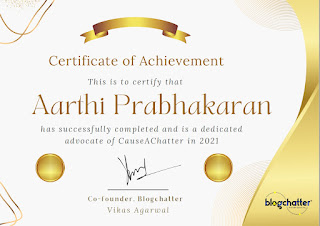
Last year, 2021, I signed up for #CauseAChatter, when I was told by Team Blogchatter that most of my blogs submitted under blogrolls qualify for the same. I stuck with the programme all through the year. Come 2022, January brought with it some great changes and some not so great ones as well. The first great thing was the certificate for being part of the CauseAChatter for 2021.

I have been offered a job in a start-up overseeing their HR operations, which is a huge thing for someone who has had a very non-traditional career path. I also decided that I wanted to pursue Masters (Post Graduation) now, 2+ decades after I completed my undergraduate studies. I was really hoping that the COVID situation will ease out with some semblance of normalcy returning into our lives.

Unfortunately, Omicron seemed to have a different idea altogether. Slowly cases are rising which has brought online schools back in full force. Even the glimmer hope that a form asking parental consent on sending older children to regular offline school just got squashed. 2+ years of online school, work from home (WFH) alternating between with and without domestic help, based on the circumstances, have had their toll on my mental health.

I was curious to know if I was the only one facing burnout and talked to some friends and found that many were going through a similar phase. It got me thinking. Here are some things that I deduced from my discussions with peers and friends on what contributes to this burnout:

  • Stunted Social Life: Restricted movements and the social distancing protocols of COVID appropriate behaviour leaves us all stuck indoors with just our family, and a few friends/neighbours who live close by our place. This is even more so when we are not in a financially privileged position to hire a private transport from our place to someone else’s place far from home.
  • Stunted Vacations: Vacations are the time to unwind. Irrespective of ones’ financial prowess, we would have one family vacation at least every 2 years away from our place of residence to enjoy the few days of change of routines or the lack of it, excitement of exploring a new place (small village or huge city), or just a change of scenery to break the monotony of life. Unfortunately, this hasn’t been possible for obvious reasons.
  • Virtual Workplaces: While there are benefits of virtual workspaces that help in keeping the continuity of work and by extension, business, and economics, it is still not an option for all. Also, the virtual workspace, I think is stunted as well, especially with respect to human interactions as it lacks the decorum that an actual workplace can provide.
  • Stunted Learning for Children: Children thrive with social interactions that involve all their senses. Online learning has them glued to the screens and a chair with no friend close by to snicker or bicker. The attention span that was already very low, to begin with has become almost negligible due to the monotony of the online classrooms.
  • Lack of personal time and space for primary care givers: For homemakers like me who hustle between homemaker and consultant/businesswomen at our convenience (read when the rest of the family is out and about, away from home), the pandemic lifestyle has been the toughest, catering to the demands of the family bringing order among the chaos that COVID brought into the daily routines by completely throwing it off track. Despite the repeated reassurance given by experts that the pandemic will soon move into the endemic mode, the light at the end of the tunnel is still not visible, especially considering the lack of change in human behaviour that is exhibited by leaders and common people alike.

Usually, when I write, I like to make sure that I also give a few pointers on how to address the issue at hand. While I do know I can give some, for the above-stated problem too, I am not sure they are enough to address the problem of burnout that people like me (Indian women, who are the unopposed primary caregivers with no choice to play the role of a secondary caregiver) are going through. And this burnout is not restricted to just people like me. It has affected every individual irrespective of age, gender, economic status and other such associated identifiers. The online space is also not safe enough to discuss our issues and vulnerabilities without a troll or a few dropping in and adding to our already overflowing basket of woes. With such a bleak picture, a deep sigh escapes me more often than usual and I find myself wishing fervently for the end to be near, for everyone's sake.

The need for safe spaces for everyone to be able to share their vulnerabilities, pain points, and frustrations has become a priority. Unfortunately, as a race, we humans have still, not even taken the first step to understanding ourselves and the biases that drive our behaviours and life choices. We are a long way from creating such safe spaces for healthy sharing and the probable start of beneficial discussions that can initiate a change.

I believe that miracles are a result of small intentional actions that would eventually drive a tsunami-like shift in our behavioural patterns, that feels like a miracle. Let us all together pledge to do our share of small intentional actions such as being self-aware, observing what is happening around us, and acting when we see someone in need of a break at least when they ask for it, shifting our focus from excellence to consistent progress (even is student performance – as parents and educators), and more.

Do share your thoughts on what other small intentional actions can bring about the tsunami-like wave that looks like a miracle?

This blog is part of Blogchatter’s #CauseAChatter challenge, #MentalHealth, #Discrimination, #AccessToEducation.

Thursday, November 18, 2021

Work-Life Balance or Balancing your Life?

This phrase work-life balance is used to explain the way an individual can and needs to bring a balance between their official work (employed or an entrepreneur) and personal life and thereby regulate the impact on one another. For me, the phrase seemed quite incomprehensible, yet I just could never explain exactly why it was so. When someone asked me that question, my response to it had the answer to the why. I always started my response with the phrase, “My work life and personal life…”. The blog that wrote about this in 2006 is also titled Balancing Work Life and Social Life as opposed to the phrase ‘Work-Life balance’.

Despite this stance, the aha moment for clarity dawned on me when recently I was having a conversation with my Spouse, and he spelled out pretty well what I was probably struggling to clearly state. 

Work is just one part of your life. 

Work is, but one component of our lives, among various other things that constitute our whole life. So how can you have a part of life in a balance with life itself? It logically/realistically can’t. Life is much larger, more like a superset (sometimes I think of it as a universal set) of work. 


With this explanation, for me, “work-life balance” loses its traditional value that work and life itself need to be given equal focus/weightage.

Once this is the perspective, priority, process, and the rest just follow, helping in the long run to practice the calm that's the first step for self-care. While the perception shift sounds easy when explained, really arriving at this mindset takes a lot of effort against generational conditioning and groupthink. 

Here are a few things that can help in reframing our thoughts to develop this healthy outlook. Once we do this, we have a hold on our well-being – mental and physical. 

Define your components of life

Explicitly defining what life means for you and maybe evening writing it down on a piece of paper or drawing a mind map of it. For some, it could just mean predominantly their work, ending up being workaholics and facing the consequences on health that workaholism can lead to. For some others, it could only mean being a part of a socially acceptable marriage institution, ending up losing their self-identity, and seeing them sacrificing their needs as a primary carer of their family.

Let go of Perfectionism

The thought that helps within assisting in this reframing our mindset to remove the focus from work and shift it to the larger image of life is the acceptance that, I am not perfect, nowhere close to being an expert. There's always a scope for us to learn from anyone and anywhere. This provides the grounding needed to accept and work with our failures (even to meet our own expectations from ourselves), in life and work. 

Guilt-free Mindset

Whichever part of the world we are from, human conditioning has a stronghold on self-driven guilt on a lot of things. Understanding the difference between necessary guilt, to ensure not repeating a mistake or a blunder and toxic guilt that cripples us from even functioning normally is a journey each of us needs to travel through self-awareness and self-acceptance.

Honing your Abilities

While the popular belief is that people are born with their abilities, I personally believe that these can be developed by anyone, at any age. An article by Pradeep Sahay on LinkedIn that highlights that the old nature vs nurture absolutist argument is probably ready to be shelved and in its place, a new approach of using context to understand the nature and nurture aspect of talent is a good place to start reading to expand our outlook. There is additional reading within the article that is helpful in adding to our knowledge and learning.

Accepting the Fluidness of Life

My favourite phrase ‘Life throws a curveball when you least expect it’ – repeating this every time in my head during the tough phases of life, helps me tackle them because there is hope that eventually when you practice tacking enough curveballs, the rude shock of the getting sucker-punched by a curveball can one day change to a pleasurable challenge of reeling in a tough situation and growing with the learning from the tackle. This also brings with it the skill of adapting/adopting to change, learning the skills to stay relevant, and growing & changing with the change that is a constant always.

Healthy Routines

When we are on the topic of change, the one thing that can keep us grounded is having healthy routines. Routines help in giving us a soft comfort that helps us deal with the rest of the chaos that is outside our power of control, as it comes. 

Setting boundaries 

Change and routine also bring us to the most important part of healthy regulation – setting healthy boundaries. Working on our conditioning, unconscious biases, understanding ourselves and working on accepting ourselves the way we are before we can start working on what changes we wish to see in ourselves would be a great place to start for setting healthy personal boundaries.

Believing in Relationships

Building relationships (in the workspace and in our personal lives) involves actively engaging in nurturing the relationship and ensuring that the basis of every relationship, trust, remains undeterred. Working on relationships also helps in creating a safety net for us to rely on when we are low on our personal strengths. While the phrase building and believing in a relationship seems simple enough, it is an emotional roller coaster ride and hence requires a lot of work on our personal emotional intelligence.

Social Life

While family and work colleagues are great, they are a given. Having a social life outside these two, building a social circle that includes, friends, causes that are close to our heart, like-minded groups sharing similar thoughts, passion, and interests, needs to be part of our social life for us to gain an enriching life experience.

We are all dispensable (replaceable) in the grand scheme of life, especially with the ‘Change being a constant’ tag line creeping up unannounced. A life well-lived (for me) means, when I am replaced (or dispensed), I have no regrets at all and am content with how I lived my life. 

While these are some of the mindful ways to have a fulfilling life as I see it, most would call these tips to have a great work-life balance. Whatever you would like to call it, these are some of the life hacks that I would stand by to make living life easier and enjoyable, considering that life always has a way to surprise us, when we least expect it. 

This blog is part of Blogchatter’s #CauseAChatter challenge, #MentalHealthTalks.

Sunday, September 26, 2021

Eco-mindfulness through Home Gardening

Being an ardent plant enthusiast & advocate of responsible living, in my perspective, the word Sustainability always brings up the twin word Mindfulness. Home Gardening (now taking shape as ‘Terrace Gardening’ or ‘Urban Farming’) has emerged as one such mindful hobby, that also contributes to sustainability in more than one way. As the pandemic added to the woes, my home garden was a blessing to help balance my health (mental, physical, and emotional), while keeping my sustainability goals. Happy to share the benefits I and my family reaped and pictures of my Green Hobby over the years!

Natural Stressbuster 
Blooms from my garden over a decade including Tulips & daffodils

When you are stressed in your daily chores, I have heard many say that taking a quick walk bare foot on Earth and feeling the soil/grass, gives us a much-needed grounding to bounce back. Based on my personal experience, this statement is certainly true. When I am in my home garden, working on the preparation of the soil bed, and caring for the plants (with trimming, weeding and such activities), I lose myself among the calmness of Mother Nature and revel in its beauty and wonder. The green of the garden (among the rest of the colours) is also pleasing to the eyes & mind and has the capacity to calm every other raging emotions. The cool touch of wet earth/grass on my bare foot makes me want to take a deep breath that sends me a message of affirmation that everything is okay, and my Earth will keep me company all my life and embrace me beyond, eliminating the feeling of loneliness.

Also, when we have blooming flowers in our garden (specifically Tulips while in the US, Dahlia, Roses and others), the beauty of the different colours of bloom was like the garden was smiling at us. Never failed to bring a smile to our faces whatever we were feeling till that instant. 

Exhilaration of Creating

The same activities of making the garden bed and caring for the seeds/saplings sown that ground me also give me a high with a sense of exhilaration when I see the shrub/herb/tree flower, laden with fruits of labour and care. Makes me feel that I have done my job as a carer right for the ground and plant flourish. It is the same feeling of seeing your child grow and achieve. This plant/tree is in a sense my child as well. 

Good Health

My Home Garden Today
When your home garden also bears vegetables and fruits, you enjoy the garden to fork experience that enables you to know that the food that you eat has been organically grown. There is also a sense of pride that this food was my effort from start (sowing it to start with) till the end (arriving as the edible dish that adorns the dining table). This also weighs much lesser on the expense pattern of the family as the monetary cost incurred in much less in comparison to a store-bought yield. 

Gardening is the best combination of physical, mental, and emotional workout that you can ever have in one single activity. 

By staying outdoors, you are absorbing natural source of Vitamin D (directly from the Sun) that helps in strengthening of bones & immune system. This also benefits weight loss as per some and helps in reducing depression. Depending on the geographical location, make sure that you step out in the right kind of sun to benefit from it.  

The physical activities that you would involve in while gardening in activities like, prepping the garden bed, sowing, weeding, watering, trimming, cleaning debris & getting rid of pests, and finally reaping the fruits of this labour also helps in physical fitness and weight reduction as different parts of your body (and hence different muscles) are used. 

It can also be a family bonding activity that enhances the emotional connectedness of the family members, especially with the younger ones. While doing so, it also serves as a tool of destressing thereby bringing a holistic wellbeing for the entire family and understanding the science behind it. The same can be the case for an entire community, when you have an option for a Community Garden.

A Sense of Agency & Empowerment

Vegetable Patches Over the years

With all the above health benefits, it translates to a hidden reduction in the cost of maintaining the personal wellbeing through not just procurement costs but also through health care and hospitalisation cost being nullified in many cases, including the most seen one of Vit D deficiency that is to be repaired with the help of medicinal/serum supplements.

If you are maintaining a Community Farm (or your friends doing some organic farming ventures in their part-time), it can cater to the needs of the local community and more, by bringing in an additional source of income when you can find the buyers for your produce through your community network. When we can showcase these benefits, we inspire more people in our sustainability journey.

Sustainability begins at home

In school I remember reading about the topsoil erosion and its impact on climate and environment. The easiest way to stop this is by growing grass native to our locality was the solution given in the textbook. Home garden is also a way by which every individual can contribute towards ending the topsoil erosion, maintain balance in water cycle (again a middle school concept), thereby positively impacting the climate change and leading to a more sustainable way of live for our next generations to survive on our planet earth.

There are a lot more benefits than what I have listed above in having a home garden. Do share your take on the same in the comments.

This blog is part of Blogchatter’s #CauseAChatter challenge - #EnvironmentalTalks and #MentalHealthTalks. 

Saturday, June 05, 2021

Four Shopping Habits to Avoid for Sustainable Living

My first blog on the series of #CauseAChatter by Blogchatter under the #EnvironmentalTalks was Baby steps towards Sustainable Living. While it is easy to read and write about such topics, to really incorporate it as a lifestyle, takes a huge level of commitment from self and the ability to lead by example. This will help to positively impact our circle of influence to follow our lead, especially when we have members from two or three generations (older or younger). 

While it took us a few years to instill these concepts in all our family members, we did start our journey with the #NeedvsWant discussions at home. Any buying decision being considered, big or small, including the weekly grocery list and vegetables, always went through this filter. This has become so much a part of our lives that even our children use this for validating their wish list! When you do not buy in excess or something that may not be used at all, then the waste generated automatically reduces at source, thereby doing our part in contributing towards maintaining a healthy environment for our future generations. 

Here are four habits on how to achieve sustainable living and helping to potentially reduce waste generation at source:

Shopping Collage from our personal travel memories

Unplanned Shopping

Planning, and sticking to the plan as much as possible under any circumstances helps to keep our expense pattern and our purchase pattern under our control, which in turn results in lesser waste generation as we are anyway buying only what we need and will use.

  • Always have a shopping list and try not to deviate from this list. 
  • Make the shopping list after taking stock of what you have at home. Only include the necessities on the list. 
  • When you have an urge to shop any additional items, evaluate the #NeedvsWant e.g. you can add an additional snack that your children may enjoy, but not overstock them.

Stress Shopping

I have had some of my friends call me for a day out shopping as a stress relief activity. This, I think, is an extremely costly and ineffective way to relieve stress. There are more efficient and effective methods of stress relief that include, exercise, practicing mindfulness (processing emotions, meditation), Yoga, gardening, and many more. 

Shopping is never a stress-buster activity. When it is for just the necessities, it contributes towards reduced waste generation at source and is light on our finances as well. 

A good alternative to stress shopping could be window shopping (no actual purchases) or moving items to an online Wishlist (instead of the shopping cart) to be reconsidered later. These are only temporary fixes. The best would be to work on addressing the root cause of the stress and completely remove it.

Extravagant Shopping

Buying items to keep the projected image of a social stature is another fallacy that would weigh heavily on our finances as well as the waste of resources and probably contribute to higher waste creation. The status definers, like trends, keep changing quite frequently, and keeping up with it might eventually even add to the stress in your life. 

Fear of Missing Out (FOMO) should never be a driver for shopping. If you shop to stay in trend, understand that in the current times, trends change every day, sometimes twice in a single day. When we base our purchase decisions to stay in line with trends, we will always be part of a game of catch-up, wasting our time, money, and resources and still not be in trend more often. All the ‘out of trend’ items pile onto the waste / useless stuff. 

Indulgent Shopping 

I fail to see the difference between this and stress shopping, but I have had advice coming my way that I should sometimes indulge myself in shopping to treat myself. I have never seen a point to this, especially when this indulgent behaviour is only a temporary fix to any problem or a mere few minutes/hours of happiness. In the long run, you will probably regret the decision of purchase, especially when it gets added to the growing pile of unused items. 

My way of indulging is different, I guess. For me, anything to do with mindfulness and sustainability is to indulge. I enjoy finding new ways to positively contribute to my family’s cost-saving and waste reduction effort, and try and do my bit towards positively impacting the society at large as well.

We aren’t Minimalistic

I wouldn’t categorise ourselves at minimalistic standards. Our conscious choices on purchase decisions indulging in Need vs Want debates have made our buying pattern moderate. This helped especially during the pandemic lockdown times as we were always aware of what was needed for our family, what was available in our stock, and when we needed to replenish them by how much. 

This enables us, as a family, to stay away from panic buying and judiciously work with the available stock till we could add more to it when we were allowed to. Lockdown restrictions only meant adjusting to the store timings rather than feeling constricted or afraid that we would not have enough.

I hope that these not-so-healthy shopping practices that we learned to tackle over the years would serve as a starting point of your self-explorative journey towards sustainable shopping habits that can also contribute to a better and healthy environment (by saving on resources and reducing waste generation at source) & better use of our personal finances. 

This post is part of Blogchatter's #CauseAChatter - #EnvironmentalTalks

Monday, March 08, 2021

Why Solocation can rejuvenate homemakers?

I have been thinking of going on a vacation by myself (solocation) for a while, but it never materialised until recently. The COVID 19 Pandemic lockdown became a catalyst to this thought and the subsequent Work-from-Home (WFH) and School-from-Home scenarios that reduced my rejuvenating “Me-time” drastically (to be read as NIL). 

My definition of me-time isn’t just reading books, creating or doing stuff that I love doing, but really absolute silence, where I can listen to and feel my own breathing, pick & look at my thoughts without judgment, be aware of everything inside and around me, what they now call being aware, mindful or meditation (No, I do not close my eyes for this, I just stay in the moment and relish it). I love staying still and doing nothing. Over the years, doing this as a regular practice has helped me cope with all the amplified chaos, that my status as trailing spouse (with international relocations) has brought for me on a golden platter (this is a topic for some other time).

There is an interesting scene from a recent Tamil movie - ‘Mookuthi Amman’ which I watched on OTT - where the brother asks his family members what their wishes were and the elder sister (who dons the homemaker responsibilities) very humbly requests ‘I need one day vacation from the kitchen’, was something I was able to correlate with, instantly. I am sure many homemakers would have had this thought in their minds sometime or the other in their lifetime! 

I would blame my socially conditioned thought process for not considering solocations early on in my life. If you are wondering what this means, here I list a few:

  • I always feared that the family would suffer if I left my home for a while. 
  • I thought I must not take off on my own for my personal pleasure, despite being an advocate of self-care myself for many of the people whom I have impacted in my professional avatar as a wellness and parenting coach.
  • Worry about so many ‘what-ifs’ plaguing my mind.
  • Being a homemaker was my choice, hence the challenges are mine to deal with.
  • I am not the only one facing such circumstances. Why am I acting as though it is just me?

I hope you now get the drift. Considering the pandemic situation, I did not want to travel too far from my home either. So, my #solocation plan was to check-in to a hotel with good amnesties, a 10 min drive from my home. 

I packed my backpack on a Friday morning, finished my lunch with my family, took a cab, and checked in to the hotel at 3 p.m. My Hubby man had booked a room with King size bed and oh boy, was I thankful!

Stepping into the room, the concierge told me that a surprise awaited me. I thought it was my husband’s doing with some surprise, but what I saw was really a heart-warming gesture from the hotel staff. On the writing desk lay a beautiful card, with an amazing message welcoming me for a great and safe solocation. They congratulated me for stepping out of my comfort zone by choosing to travel solo and comforted me with the assurance of safety during the duration of my stay. This hotel – Novotel OMR - won me over that instant (though I already was a great fan of their hospitality, having experienced them in other countries).

A picture of the welcome note from the hotel staff

That gesture was a big step towards easing the doubts that were rearing their ugly head on my decision to go solo. The rest of my stay during the weekend was pure bliss. The benefits I enjoyed during my stay:

Completely Rested: Sleep early and wake up early and refreshed the entire day – my comfort schedule which I had forgotten since motherhood; changed to, sleep late wake up early, and stay exhausted. Oh… The King-sized luxury bed was quite the comfort and I slept like my husband. (I recently read a quote on my friend’s FB wall – I do not want to sleep like my baby, I wish to sleep like my husband. I am sure you get the drift.)

Stomach full without having to cook: Eat filling meals without having to think about what to cook and then actually cooking them! Being weekend, the breakfast buffet at Novotel was filled with choices including South Indian and North Indian choices. I had my fill all three mornings – Saturday, Sunday, and Monday. Oh! And there was Galette (My French colleagues will relate to this dish) too. I felt so stuffed that I skipped lunch. I can still feel the refreshing taste of the breakfast on my taste buds. Their to-order coffee was perfect. Novotel OMR weekend breakfast menu is one of the best.

Experiencing Hospitality: Amazing staff at the restaurant. Always serving with a smile and every happy to oblige any service I requested. Welcoming me every morning with a cheery ‘Good morning’. Enquiring me about my stay and how I was liking the food. I felt like royalty! 

Productive Work Meetings: Yes, I got some office work done too. I was able to get a lot of my writing assignments completed, did some brainstorming for one of the volunteering initiatives, and was also able to catch-up with my old friends over undisturbed phone calls. All this without distractions or disturbances at my home or the doorbell going off every now and then.

Reading: I did get to read a lot on the digital platform. I had also packed a book ‘Teaching through the Heart’ by Meera Ravi which I have been wanting to read for a while now. I missed my reading-for-hours-without-disturbance mode. These two days I was able to do that as well. 

Silence: I had all the silent me-time I could ask for. Doing all the above, I still got this silence, and it helped me in calming myself and come back home with a fresh perspective and a smiling persona that my entire family noticed the change!

On my return on Monday, I had an extended surprise waiting for me at home. 

Lunch was prepared by my Hubby and ready for me to eat. I did not have to come home and immediately resume duties. I had time till dinner for me to take over.

Last but definitely not the least reason to make solocation a normalised event in every household. I got to hear these words from my spouse’s mouth, ‘Now I know how you make things look easy. Two days when I had to hold fort, there were a lot of things I realised were not as easy as I thought they were’.  For example, seems our son rated his morning health drink prepared by his Dad as ‘okay, but needs improvement’. That made him realise how many zillion times I had prepared the same thing, to meet the needs of every individual at home. ‘Though I only did a fraction of things in comparison to what you do daily, I was exhausted by nightfall, both days. I knew being a homemaker was not easy, but I really got a glimpse of how extremely exhausting and difficult it is and for years you never let any of us feel this side of it. You deserve these breaks more often.’

And I have a champion in my son. He said, ‘Amma needs her rest and downtime. She is overworked and less rested. We will all do our chores and pitch in more regularly.’ I do not have to remind them about their home chores (at least not that frequently). The family is more sensitive to my needs, fluctuating moods, and exhaustion. They are now conscious of my office work and hence are more participative in household tasks more. We have family lunches and dinners more frequently where conversations (all kinds) are helping build healthy connection rituals resulting in a secure attachment. These small changes in our family helped the homemaker in me feel valued and that it is now well acknowledged and appreciated by everyone in the family.

My son and spouse are the organisers, sensitive, and emotional characters while I and my daughter are the logical decisive quick thinking and emotionally stronger individuals in the home. She loves pointing out in every possible situation that our family would probably win the award for the ‘maximum stereotypes broken’ category if there was one anyway and feels so much pride and contentment when she states this. 

What more can I ask for? Along with a relaxed and rejuvenated me, I also have a spouse who appreciates what I do much more than before. I think solocations occasionally are beneficial in more than one aspect. I see more of such solocations in my future! I would urge all homemakers (in fact each one in any capacity) also to go ahead and try it out, at least once, if not for anything else, but their personal wellbeing, as part of a self-care practice. 

If you have already had these in your past, would love to hear of your personal experiences as well and understand what other benefits that this can offer (for self and the family as a whole).

This post is part of #CauseAChatter #MentalHealthTalks with Blogchatter. 

Wednesday, February 10, 2021

#Dysphoric – A four-part documentary series by Vaishanvi Sundar

I am quoting the synopsis from the movie crew, as I feel that there can be no better way to clearly communicate what this documentary series is all about. 

Synopsis:

In this dystopian world where misogyny is rampant, and womanhood is commodified, being female comes at a cost. Corporates capitalise on women's bodies blurring the lines of biological sex and profiting from the empirically untested pseudo-science of queer theory. This gaslighting is aided by the complicity of media, academia, legal and the political world. It is no surprise that young girls are fleeing womanhood like a house on fire.

The past decade has seen a steep rise in the number of young girls seeking to transition by undergoing life threatening, irreversible procedures. ‘Dysphoric’ is a four-part documentary series on the rise of Gender Identity Ideology, its effects on women and girls - especially in developing countries. 

The film explores gender transition, the permanent medical side-effects of hormones and surgeries, the propaganda by 'woke' corporations that glorifies thousands of stereotypical gender presentations coalesced as fashion, a surge in pronoun policing; language hijacking that calls women ‘menstruators’, and the many hurdles women face while trying to question this modern-day misogyny. The film amplifies the voices of detransitioners, clinicians, psychiatrists, sociologists, feminists, academics and concerned citizens.

I was intrigued to watch the documentary series because of the message on the director’s FB timeline, which stated that she would keep uploading every time it gets pulled down. She also is looking for someone to help her to write or talk about this on mainstream media, as she feels that this needs to get attention and discussed as well and I concur. 


The series talks about the narrative surrounding the #GenderDysphoria diagnosis, ensuing hormone-blocking practices, and gender change surgeries by professionals, dissenters, and detransitioners, highlighting the various issues including certain gaps in processes that need to be followed. The focus is on the traumatic experience of the whole transitioning and detransitioning process, which includes not just the physical trauma, but also the emotional rollercoaster and the most pertinent question of ‘informed consent’ for gender change procedures and surgeries by children younger than 16 years of age, when they are developmentally too young to understand the concept of static duality of biological sex and gender identity. 

The 4-part series progressively addresses the various layers of issues surrounding this and why it is essential that we all understand and remain curious about what Gender Dysphoria (#GD) means, without oversimplifying the equation of #GD and Gender Identity. As we view one part after the other, we realise why it is important to create safe spaces to talk about the condition much longer, go through therapy to delve deeper and understand the condition before arriving at a concrete course of action addressing the GD, especially if the action is to embark on an irreversible physical life-altering decision!

There are #detransitioners and #dissenters, their family and therapist also sharing their journey and hence I think this documentary needs to be watched by anyone and everyone as gives a perspective that is easily relatable, irrespective of who you are. Please take some time out to watch this series and understand more about Gender Dysphoria and its ramifications in our world, especially for a woman. 

This post is part of #CauseAChatter with Blogchatter. #LiftEveryVoice