Showing posts with label Pandemic Lifestyle. Show all posts

Wednesday, March 30, 2022

Is your Family a Potato or a Banyan?

In the past couple of years, the pandemic lifestyle has removed the private space for adults to have discussions that may become heated, especially when the discussions are about logistics of planning family gatherings, vacations/trips, and functions. Living with each other 24 x 7 with little or no possibility of stepping out of the home for change of environment or company, kind of made us bicker at each other (even heightening the ‘sibling discord’ moving it to a slightly unhealthy level of displeasure) till, we finally realised that mixing a healthy dose of humour into our everyday lives would help.

There were two incidents in the recent months that happened I would like to share with you and hope that there is something you will also be able to take away from these anecdotes for your life and your sanity.

During one such planning discussion that happened on a day when my first born decided to take an off from regular school that resumed recently, I made a statement to move into a different room so spare her the trauma of the two of us arguing.

Illustration by my daughter M
Illustration by @mizumika
My first born (M) remarked, ‘How strongly grounded our family is!’

My spouse (B) said, ‘Grounded and rounded like potato.’

‘No Appa, well grounded and rooted like the banyan’

‘Potato is found under the soil’ said B, and I chipped in, ‘it is tasty, starchy and hence can replace the main staple food of our household, which was rice.’

B continued, ‘It also is representative of what we as a race have become, couch potatoes, enjoying stuff that keeps us constantly in a sitting posture. It can also wither wildfires and storms, unlike a banyan.’

‘We talk so much about how we are like potato but none of us here eat or like mashed potato.’ retorted M.

‘I love it’, in unison chimed I and B, and I continued, ‘While we love potato, in almost all forms of it, we also need to know that eating too much of it would make us feel stuffed and result in farting’.

M, ‘WOW! I am sure no other family would have equated a family staying grounded and connected, to a potato. I was thinking of a banyan tree, when I mentioned our family is strongly grounded, with so many roots that it will not be disturbed or harmed in any kind of storm. Only our family could think so off the charts and bring up a potato and in the context of our family deeply under the ground grounded... like at least 4-6 ft pit in the ground deep… like the other day when Appa went out, and R absent mindedly kept calling out for him, adding to our streak of breaking stereotypes as a family.’

Now B wanted to know what we were talking about. So here is the second incident.

A couple of weeks ago, B stepped out on a weekend morning to run some errands that kept him out for a while. My son (R) hates silence and being alone. He constantly needs company, and his mouth will always be on speaking mode to the one who is sitting beside. This constant conversation drains me out as I need my silence to rebound. My spouse has mastered the art of responding without really listening and not making it too obvious to anyone else but me. In my case, I wouldn’t blame him for getting caught in the act of phasing out, it probably is me who catches it almost immediately. :-D

So that day, B got ready and before stepping out he told R that he will come for lunch at 2 p.m. and that by then R was supposed to finish his classwork and homework from the previous week that were still pending – result of the adjustment period of going back to regular mode of school after 2+ yrs of online school. B left saying bye to everyone personally. R was sitting at his desk upstairs in our duplex home.

For almost 5 minutes, every few seconds, he kept calling out for his father ‘Appa, Appa,…’

The first couple of times I and M tried telling him that Appa had gone out and will be back only at 2 p.m. At one point we both could not stop our laughter at his cuteness, and he felt that we were laughing at him. So, I called him down, gave him a bear hug first and said, ‘We are not laughing at you chellam. We are admiring your cuteness.’

This calmed him a bit. I and M took turns explaining, ‘We also are laughing at how our family has added one more aspect to the streak of breaking stereotypes as a family with this. In most homes, the child almost always calls out to the mom, Amma, Amma, but only in our home the sound we hear is for the father. And when you call out for Appa you sound very cute.’

He joined us in our laughter happily.

A family that laughs together produces enough endorphins that help in strengthening the relationship bonds, in addition to contributing towards personal wellness. Even the most difficult conversations are made easy with humour. I really do hope some day the stereotypes vanish from the face of earth because then there would be more families that embrace the concept of ignoring stereotypes and does only what work for the family.

This blog is part of Blogchatter’s #CauseAChatter challenge, #MentalHealth, #Discrimination.

Sunday, January 16, 2022

Pandemic and Family Wellbeing

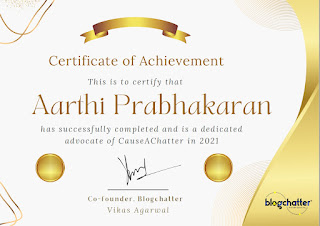
Last year, 2021, I signed up for #CauseAChatter, when I was told by Team Blogchatter that most of my blogs submitted under blogrolls qualify for the same. I stuck with the programme all through the year. Come 2022, January brought with it some great changes and some not so great ones as well. The first great thing was the certificate for being part of the CauseAChatter for 2021.

I have been offered a job in a start-up overseeing their HR operations, which is a huge thing for someone who has had a very non-traditional career path. I also decided that I wanted to pursue Masters (Post Graduation) now, 2+ decades after I completed my undergraduate studies. I was really hoping that the COVID situation will ease out with some semblance of normalcy returning into our lives.

Unfortunately, Omicron seemed to have a different idea altogether. Slowly cases are rising which has brought online schools back in full force. Even the glimmer hope that a form asking parental consent on sending older children to regular offline school just got squashed. 2+ years of online school, work from home (WFH) alternating between with and without domestic help, based on the circumstances, have had their toll on my mental health.

I was curious to know if I was the only one facing burnout and talked to some friends and found that many were going through a similar phase. It got me thinking. Here are some things that I deduced from my discussions with peers and friends on what contributes to this burnout:

  • Stunted Social Life: Restricted movements and the social distancing protocols of COVID appropriate behaviour leaves us all stuck indoors with just our family, and a few friends/neighbours who live close by our place. This is even more so when we are not in a financially privileged position to hire a private transport from our place to someone else’s place far from home.
  • Stunted Vacations: Vacations are the time to unwind. Irrespective of ones’ financial prowess, we would have one family vacation at least every 2 years away from our place of residence to enjoy the few days of change of routines or the lack of it, excitement of exploring a new place (small village or huge city), or just a change of scenery to break the monotony of life. Unfortunately, this hasn’t been possible for obvious reasons.
  • Virtual Workplaces: While there are benefits of virtual workspaces that help in keeping the continuity of work and by extension, business, and economics, it is still not an option for all. Also, the virtual workspace, I think is stunted as well, especially with respect to human interactions as it lacks the decorum that an actual workplace can provide.
  • Stunted Learning for Children: Children thrive with social interactions that involve all their senses. Online learning has them glued to the screens and a chair with no friend close by to snicker or bicker. The attention span that was already very low, to begin with has become almost negligible due to the monotony of the online classrooms.
  • Lack of personal time and space for primary care givers: For homemakers like me who hustle between homemaker and consultant/businesswomen at our convenience (read when the rest of the family is out and about, away from home), the pandemic lifestyle has been the toughest, catering to the demands of the family bringing order among the chaos that COVID brought into the daily routines by completely throwing it off track. Despite the repeated reassurance given by experts that the pandemic will soon move into the endemic mode, the light at the end of the tunnel is still not visible, especially considering the lack of change in human behaviour that is exhibited by leaders and common people alike.

Usually, when I write, I like to make sure that I also give a few pointers on how to address the issue at hand. While I do know I can give some, for the above-stated problem too, I am not sure they are enough to address the problem of burnout that people like me (Indian women, who are the unopposed primary caregivers with no choice to play the role of a secondary caregiver) are going through. And this burnout is not restricted to just people like me. It has affected every individual irrespective of age, gender, economic status and other such associated identifiers. The online space is also not safe enough to discuss our issues and vulnerabilities without a troll or a few dropping in and adding to our already overflowing basket of woes. With such a bleak picture, a deep sigh escapes me more often than usual and I find myself wishing fervently for the end to be near, for everyone's sake.

The need for safe spaces for everyone to be able to share their vulnerabilities, pain points, and frustrations has become a priority. Unfortunately, as a race, we humans have still, not even taken the first step to understanding ourselves and the biases that drive our behaviours and life choices. We are a long way from creating such safe spaces for healthy sharing and the probable start of beneficial discussions that can initiate a change.

I believe that miracles are a result of small intentional actions that would eventually drive a tsunami-like shift in our behavioural patterns, that feels like a miracle. Let us all together pledge to do our share of small intentional actions such as being self-aware, observing what is happening around us, and acting when we see someone in need of a break at least when they ask for it, shifting our focus from excellence to consistent progress (even is student performance – as parents and educators), and more.

Do share your thoughts on what other small intentional actions can bring about the tsunami-like wave that looks like a miracle?

This blog is part of Blogchatter’s #CauseAChatter challenge, #MentalHealth, #Discrimination, #AccessToEducation.