Wednesday, February 23, 2022

'The Miracle is us… All of us..' Encanto – Movie Review

Source - Disney, Encanto - Google Images
Encanto seems to be a raving success, especially among the 6 – 15-year-old for sure. Read on to know why it could be so.

I am also seeing many schools and organisations picking and choosing the characters of this movie and coming up with Escape Rooms, debate and discussion topics in schools and children study groups (outside schools too). Now that I have shared a link, I think a couple of disclaimers are also necessary to be cleared in the get go:

  • This is not a sponsored / paid promotional post either for Disney, Encanto or for the other service organisations that get mentioned or linked here.
  • The opinions in this blog are mine based on my perspective about the movie and it may or may not be matching those of the makers and researchers of the movie.
  • Spoiler Alert: The blog may reveal more about the movie and its nuances, so if you would like to come back to this blog after watching the movie, I would recommend you save this blog for later reading, and go and watch the movie first – in which ever language you understand and are comfortable to watch it in.

Family of Madrigal

Let us take the song at the start of the movie, which is about the Family of Madrigal (The Family Madrigal). The Madrigal Family is bestowed upon by a miracle, when Pedro, Alma Madrigal’s (abuela) husband, is killed during the armed attack on their village. This miracle helps the rest of the survivors hide (after blasting the attackers) in the form of a charmed hidden place called Encanto surrounded by the mountains of Columbia, and a magical candle that keeps the magic alive and ensures the protection of the people who survived this armed attack. 

Source - Disney Encanto - Google images
I personally loved the song and was waiting eagerly till the end of the song only to realise that the family and entire village did not know what Mirabel’s gift was. I thought her gift was being able to understand the miraculous Madrigal House itself, in the way the song was picturised. By the end of the song, she would have introduced every member of her family and their unique yet prized gifts that they were blessed upon, in their childhood. The ending of the song showed how the family, or the village was oblivious to an obvious gift only because they could not see the magic that Mirabel was capable of, because it did not fit the norm that was expected by the mass. 

‘Each new Generation MUST keep the miracle burning’ – The word MUST shows the implicit expectation and the possible pressure that this expectation can have on all the family members of Madrigal, especially when Mirabel’s gift seemed to have skipped (but in reality, it wasn’t just what the family and the town people expected. Her gift was part of what we know to be an intangible skill). In fact, I thought Mirabel had more than one gift in the song itself – compassion, empathy, and ability to understand everyone and everything around her – all intangible skills that probably can’t be measured in any traditional sense. 

When Mirabel is ready to go home and a small girl with flower in her plaited hair, asks her ‘What is your gift?’, first I saw a representation of women and girls from my country who wear flowers in the exact same manner and was pleasantly surprised. Kudos to Disney for bringing in narratives that were representative of the many different people and cultures in the world. This one family had many different shades of skin too in the family members and hair types as well, which is again a huge shift from the stereotypical white representative characterisation of even (South) Asian characters like Jasmine and Mulan. 

The end of the song where Mirabel struggles to get out from the incessant questions of the children about her gift because she was made to believe that she did not have one, because the family did not understand what her gift really was when she received it, shows the real pain that every person who is different from the majority goes through in family or in any kind of team/group, even in a work situation. The typical way of her cousin blurting out that Mirabel did not get one and the obvious shock registered on the children’s faces and the sense of disappointment and shame at self for failing such an extraordinary family of gifted individuals, is the best representation of what many of us probably go through in real life (a version of imposter syndrome), until they are able to accept themselves for who they are (albeit different from the rest, yet special) and celebrate their uniqueness before the rest of the world can see it for themselves.

Waiting on a Miracle: This very next song that follows The Family Madrigal song, tugged at my heart strings mainly because of the emotions that it invoked with the picturisation of the Mirabel’s longing to be accepted as being worthy of this family of gifted individuals, the characterisation of the family and subtle undercurrent that was established by then, by most family members who thought Mirabel was a sign of doom or mediocrity. 

Pressure of Perfection & Social Emotional Learning (SEL)

Mirabels’s sisters Luisa (the strong one) and Isabela (the symbol of perfection) express their anxiety and stress stemming from the fear of failure. Luisa sings about her anxiety due to the failure affecting her strength (her miracle gift). She would like to have a break from shouldering the weight of expectation of always exhibiting strength and progress and have some time to deal with herself and her self-doubts. On the same note, Isabela brings a point of view of having to stick to only a few of the things that she can do because she is expected to be perfect in what she creates using her magic. She longs to want to try to see what more she can possibly create with her gift and her experimental efforts yield a beautiful outcome. Yet, it angers their abuela, who reprimands Mirabel implying that her involvement might negatively impact the magic of gifts (and fearing that it might probably even weaken the magic’s strength) bestowed upon their family and the protection it provides to their village. 

Source - Disney, Encanto - Google Images
“The elephant in the room” suffering from this pressure of perfection is Mirabel’s uncle, Bruno. The story unfolds showing that the family shuns Bruno because of his gift of precognition (reminded me of the Minority Report and the precogs from the movie). This skill again is stunted because of the pressure of perfection that is expected from Mirabel’s abuela (who is probably driven by her fear), as stated by Bruno. He is never good enough is the idea that seems to have been deeply personalised by him, due to which he decides to stay hidden from the family, by living in the spaces between the walls of the magical house. He also thinks that the family and the village only expect him to have positive visions, and when he has an incomplete vision or a not to great vision, he gets anxious about performance issues. When Mirabel also pushes him to show her the complete vision that he had about her, he visualises Mirabel needing to embrace a young woman (assumed to be Isabela) and embrace the relationship with its flaws and the person itself for who she is (strengths and vulnerabilities intact). 

The movie does go on to unfold a different plot, which is great to watch and understand the bigger picture, stressing the importance of SEL in understanding self and the others as well, in the family or in the context of any relationship in our lives. It also brings up the issue of how trauma of early years can impact the perceptions and life decisions of an individual, and how essential it is to embrace ourselves with our abilities and vulnerabilities as well and know when to ask family/friends for support. 

Many of these are feelings and emotions that the children between the age group of 6 & 15 go through due to the pressure of expectation from family, carers, educators, and well-wishers. While we all mean well, somewhere we need to keep a check on what drives our care and expectations and make sure it is not our unfounded fear that drives our expectations/actions, as we might run the risk of making the children feel suffocated with our care.

Diversity, Representation & Inclusion

For the first time, I have been ecstatic seeing so many different characters with different physical features, including the type of hair, the placement of flowers on the hair, the accessories worn, the colour & texture of the hair with differences that is representative of the real people’s physical features and cultural accessories that are used. A story that revolves around real life incidents (and not some fairy tale) that are very relatable, even when one may not know the historical event that probably inspired the story line. 

Mirabel looks like my friend from my school days, and this is a feeling not just for me, even my daughter feels that maybe because the character’s design is like an everyday person you come across in your life (not a larger-than-life princess). The small girl with the flower in her plaited hair reminded me of my cousins and myself in our childhood when we had that long a hair, which was oiled and plaited, and flowers adorned them (if not daily at least once a week). The entire family of Madrigal and its members are like any of our (extended) families. In India till recently, joint families that large lived under the same roof. I grew up in one such family! 

At the end of the movie, the entire family accepts everyone as they are, is understanding of their vulnerabilities and embraces them with these vulnerabilities… And the song ‘All of You’ is a treasure to listen, summarising all the learnings of every character in the movie, for us to take along with us when we walk out of the movie. Here is the portion from that song that I love the most:

But the stars don't shine, they burn
And the constellations shift
I think it's time you learn
You're more than just your gift
And I'm sorry I held on too tight
Just so afraid I'd lose you too
The miracle is not some magic that you've got
The miracle is you, not some gift, just you
The miracle is you
All of you, all of you
(Credits - Encanto, Disney)

Let us all take this with us always to be remembered, ‘the miracle is us, all of us’ and make this our guiding thoughts for every action of ours, including building and nurturing relationships (personal or professional). This is one movie (of a few of the more recent movies that focuses on the cultural diversity, equity & inclusion in addition to relatability, like Coco – maybe a review of that soon 😉) I would recommend that each one of us see and show to our young ones and have discussions around the various characters, their stories, their issues and how could that be overcome if this was something that we knew was a personal problem for any of our family members or friends. 

This blog is part of Blogchatter’s #CauseAChatter challenge, #MentalHealth, #Discrimination.

Sunday, January 16, 2022

Pandemic and Family Wellbeing

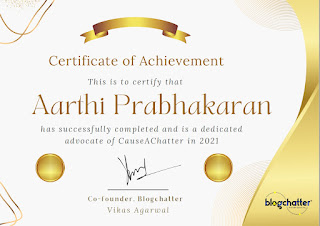
Last year, 2021, I signed up for #CauseAChatter, when I was told by Team Blogchatter that most of my blogs submitted under blogrolls qualify for the same. I stuck with the programme all through the year. Come 2022, January brought with it some great changes and some not so great ones as well. The first great thing was the certificate for being part of the CauseAChatter for 2021.

I have been offered a job in a start-up overseeing their HR operations, which is a huge thing for someone who has had a very non-traditional career path. I also decided that I wanted to pursue Masters (Post Graduation) now, 2+ decades after I completed my undergraduate studies. I was really hoping that the COVID situation will ease out with some semblance of normalcy returning into our lives.

Unfortunately, Omicron seemed to have a different idea altogether. Slowly cases are rising which has brought online schools back in full force. Even the glimmer hope that a form asking parental consent on sending older children to regular offline school just got squashed. 2+ years of online school, work from home (WFH) alternating between with and without domestic help, based on the circumstances, have had their toll on my mental health.

I was curious to know if I was the only one facing burnout and talked to some friends and found that many were going through a similar phase. It got me thinking. Here are some things that I deduced from my discussions with peers and friends on what contributes to this burnout:

  • Stunted Social Life: Restricted movements and the social distancing protocols of COVID appropriate behaviour leaves us all stuck indoors with just our family, and a few friends/neighbours who live close by our place. This is even more so when we are not in a financially privileged position to hire a private transport from our place to someone else’s place far from home.
  • Stunted Vacations: Vacations are the time to unwind. Irrespective of ones’ financial prowess, we would have one family vacation at least every 2 years away from our place of residence to enjoy the few days of change of routines or the lack of it, excitement of exploring a new place (small village or huge city), or just a change of scenery to break the monotony of life. Unfortunately, this hasn’t been possible for obvious reasons.
  • Virtual Workplaces: While there are benefits of virtual workspaces that help in keeping the continuity of work and by extension, business, and economics, it is still not an option for all. Also, the virtual workspace, I think is stunted as well, especially with respect to human interactions as it lacks the decorum that an actual workplace can provide.
  • Stunted Learning for Children: Children thrive with social interactions that involve all their senses. Online learning has them glued to the screens and a chair with no friend close by to snicker or bicker. The attention span that was already very low, to begin with has become almost negligible due to the monotony of the online classrooms.
  • Lack of personal time and space for primary care givers: For homemakers like me who hustle between homemaker and consultant/businesswomen at our convenience (read when the rest of the family is out and about, away from home), the pandemic lifestyle has been the toughest, catering to the demands of the family bringing order among the chaos that COVID brought into the daily routines by completely throwing it off track. Despite the repeated reassurance given by experts that the pandemic will soon move into the endemic mode, the light at the end of the tunnel is still not visible, especially considering the lack of change in human behaviour that is exhibited by leaders and common people alike.

Usually, when I write, I like to make sure that I also give a few pointers on how to address the issue at hand. While I do know I can give some, for the above-stated problem too, I am not sure they are enough to address the problem of burnout that people like me (Indian women, who are the unopposed primary caregivers with no choice to play the role of a secondary caregiver) are going through. And this burnout is not restricted to just people like me. It has affected every individual irrespective of age, gender, economic status and other such associated identifiers. The online space is also not safe enough to discuss our issues and vulnerabilities without a troll or a few dropping in and adding to our already overflowing basket of woes. With such a bleak picture, a deep sigh escapes me more often than usual and I find myself wishing fervently for the end to be near, for everyone's sake.

The need for safe spaces for everyone to be able to share their vulnerabilities, pain points, and frustrations has become a priority. Unfortunately, as a race, we humans have still, not even taken the first step to understanding ourselves and the biases that drive our behaviours and life choices. We are a long way from creating such safe spaces for healthy sharing and the probable start of beneficial discussions that can initiate a change.

I believe that miracles are a result of small intentional actions that would eventually drive a tsunami-like shift in our behavioural patterns, that feels like a miracle. Let us all together pledge to do our share of small intentional actions such as being self-aware, observing what is happening around us, and acting when we see someone in need of a break at least when they ask for it, shifting our focus from excellence to consistent progress (even is student performance – as parents and educators), and more.

Do share your thoughts on what other small intentional actions can bring about the tsunami-like wave that looks like a miracle?

This blog is part of Blogchatter’s #CauseAChatter challenge, #MentalHealth, #Discrimination, #AccessToEducation.

Sunday, December 05, 2021

My Volunteering Journey

My association with Blogchatter started with the team reaching out to me saying that many of my blogrolls submitted qualify for the #CauseAChatter challenge that had just begun in the first quarter for this year. This was in Feb. this year as soon as I joined the platform creating my profile. While this marks my journey as a #CauseAChatter champion, my journey as a volunteer began when I was in 6th Grade at school. The earliest I remember was enrolling myself as a part of Scouts & Guides team. I remember wanting to be part of the National Service Scheme (NSS) during my secondary years, but my new school did not have NSS. 

My blogs are a means for me to share my lived experiences in my life, filled with changes and learning from adapting and dealing with the constant changes that I have gone through as a student (K12 completed in 7 different schools) as well as an adult glomad (resident in 4 countries on 3 continents in a span of 13 years).

This year’s UN theme for International Volunteer Day is Volunteer now for our common future. On this day, this makes a lot of sense for me in my mid-life, I can’t claim that I knew about this as a child or even as a young adult. Yet the warmth I felt, when I volunteered and saw that my time and effort created a positive impact wherever I was able to contribute, was something that I wanted to keep. This is what made me to continue volunteering my time, effort, and skills in every place I resided. Once I settled into the new place, I would seek out the local community centre or NGO through the network of friends that I made in the initial phase and start my volunteering journey working for the cause that I felt at home with, in the local community. 

Over the years, I have faced one question that I have always struggled to answer with conviction, not because I did not believe in volunteering, but because I never really paused to think what was it that always brought me to volunteer my time and effort and not my money that I earn from my profession. There have also been times when I have felt low when peers and juniors (sometimes even seniors) have made statements to the effect that excellent skills were probably not used enough to support myself towards mending/uplifting my career path. 

Thanks to Blogchatter’s question for this International Volunteer Day on what #Unstoppable means to me as a #CauseAChatter Champion, my mind raced down the memory lane to come up with the answer to why I always kept being pulled towards volunteering.

Working for a cause is always measured by the impact that it has created and for me this measure was always important. The purpose of my work, I preferred to measure with the impact that it had/has in the overall schema of things. Most people associate success to a number (either the figure of salary that reached our bank accounts, the ordinal number in the race of life, or the hierarchical position in the career ladder), for me it meant the feeling of contentment for me and if someone else also benefited from my work, then that is the cherry on the cake. Volunteering never failed me in this. 

There are different kinds of volunteering based on what you are willing to volunteer: Financial Aid, Time, Expertise & Effort. All of them are essential components to be able to bring the required impact.

While I know what benefit I gained, the measure of impact that my contribution is some instances are unknown so far, maybe because they were seeds of thought planted to initiate/enable change and I had to relocate from there before I could see the progress of my planted seed.

Blogging (close to 2 decades) here & on Momspresso (for the last 3 years), and answering on Quora (at least the last 3 years) is another voluntary activity that I have had the pleasure of doing. This is my way to leaving behind responsible digital footprints of my lived experience and knowledge gained from these experiences, for the future generations to come, because what you put online, remains there forever.

What is in it for me?

This is one question I have faced time and again from many, despite the higher personal benefit gained from volunteering experience. So here I am listing it out again, hoping that this article will serve as my answer in future the next time I encounter the question.

  • Personal Satisfaction of Serving by impacting: While financial independence may not be there, I get the experience of deciding how the funds, shared by those volunteering funds for causes close their heart, get utilised to positively impact the recipients of the cause.
  • Knowing that my skills are directly being used to impact changes at the grass root level issues and hence will bring a better changed perspective and maybe by extension a better world for our future generations, because I am on the ground working at the grass root level and hence see this impact sooner than most.
  • It also helps me identify the causes at the grass root level to give me a front row seat view of how concepts of social and parental conditions, community groupism drive the group think. So, while solutioning, inclusion comes naturally due to having experienced these things on the field rather than just reading a passive version of it in books in the form of theories.
  • Helps me become a better person because mindfulness becomes a way of life in every role I don as part of a larger group/community. I am aware that the world of opportunities and privileges aren’t the same for everyone, even within the same community and hence the solutions or community level programmes need to be open and flexible enough to accommodate for this kind of variations, is a deeply ingrained lesson from practically experiencing it.
  • The personal detachment also becomes a way of life, while receiving feedback and criticism. Both success and failure are transient, is something that I have learned over the years, and hence the criticisms have started becoming less personal and less trigging. Equally, appreciations bring momentary pleasure, they never get to the additive phase, and I can move on to the next goal or cause that I identify for myself to work for the community wellbeing (that will eventually also cater to my wellbeing).
  • Success and failure are impact based rather than number based, which is a huge change in perspective but very calming for my personal self. I am out of the rat race because I know why I am working and not doing it because everyone aspires success. I also do (aspire for success), but just that my success definition has changed.
  • It allows me to experiment and learn skills outside my expertise and comfort area through online certification courses that contribute to the Continuous Professional Development (CPD) and growth.
  • The freedom to work outside the comfort zone also gives me scope relook at my educational qualification based on the country's acts and regulatory norms before I can narrow down on the right degree to top my current qualifications to continue my personal journey of skilling and qualifying, that would enable me to contribute towards the cause and the community with more relevancy and expertise.
  • Builds my personal and professional network and helps in personal self-care (with a sense of contentment and accomplishment) for the multitude of reasons mentioned above.
While #sustainability and #EnvironmentalTalks invoke the thought of green initiatives and reduce, reuse & recycle, I think the sustainability and environmental talks are incomplete without the impact of the role of volunteering and volunteers in these. On this International Volunteering Day, sharing my continuous tryst with volunteering till now and one that will continue in future also, is my dedication to this year’s theme in urging those of you who happen upon this blog to start volunteering to experience and enjoy what I have, and if you already are a volunteer, then to continue your journey.

This blog is part of Blogchatter’s #CauseAChatter challenge (#EnvironmentalTalks & #MentalHealthTalks) and #CauseAChatter Projects.

You can find all my blogs written for the #CauseAChatter challenge here.

You might also like to read: